
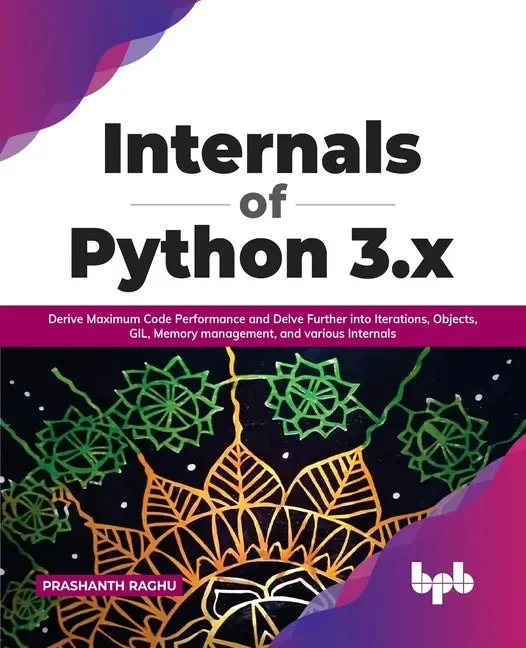
Description
Report copyright infringement
by
Prashanth Raghu (Author)
Deroute the syntactical way and start exploring the language from the sourceKey FeaturesIn-depth practical understanding of CPython’s internal -by-step source code walkthrough utilizing descriptors on source code -edge coverage of the interpreter, GIL, compilation, and memory allocations to help you develop better of Python 3.x transform a programmer’s learning path by emphasizing the source code over the syntax to teach things from the ground up in nearly the same amount of time and book delves into the structure and distinctions between the primary Python object and iterable objects. The iterable types, namely, lists and tuples, have been thoroughly defined in the structure and operations. The internals of sets and dictionaries, which are data structures that provide O(1) insertion and search, have been thoroughly discussed. Memory allocation explains how Python handles memory for tiny and large objects. The chapter on GIL explains how the GIL works, which is halted by a semaphore and a conditional variable. The chapter on Async Python describes how the async module generates coroutines and async functions that can be executed on an event loop and interact through reading this book, you will be more confident to create high-performance code on a day-to-day you will learnUtilize data structures effectively for a variety of application how to optimize Python code an understanding of memory optimization and how to design programs the inner working of GIL and Interpreter in the internals of the garbage collection and reference counting this book is forThis book is intended for Python practitioners, new coding aspirants, and experienced Python developers who want to construct their frameworks and libraries by investigating tokenizers, parsers, code compilers, interpreters, memory management, GIL, and garbage collection. Prior programming skills in C may help you get the most out of this of Contents1. Design of Generic Objects2. Basic Python Types3. Iterable Sequence Objects4. Set and Dictionary5. Functions and Generators6. Memory Management7. Interpreter and Opcodes8. GIL and Multithreading9. Async Python10. Source Code Layout and the Compiler StagesRead more
Number of Pages: 236Dimensions: 0.5 x 9.25 x 7.5 INPublication Date: January 07, 2022


Reviews
There are no reviews yet.